
Identifying Connectors
There are a dizzying number of analog audio-video connectors out there. This guide will help you keep them straight and determine which cable type is right for you.
SCART
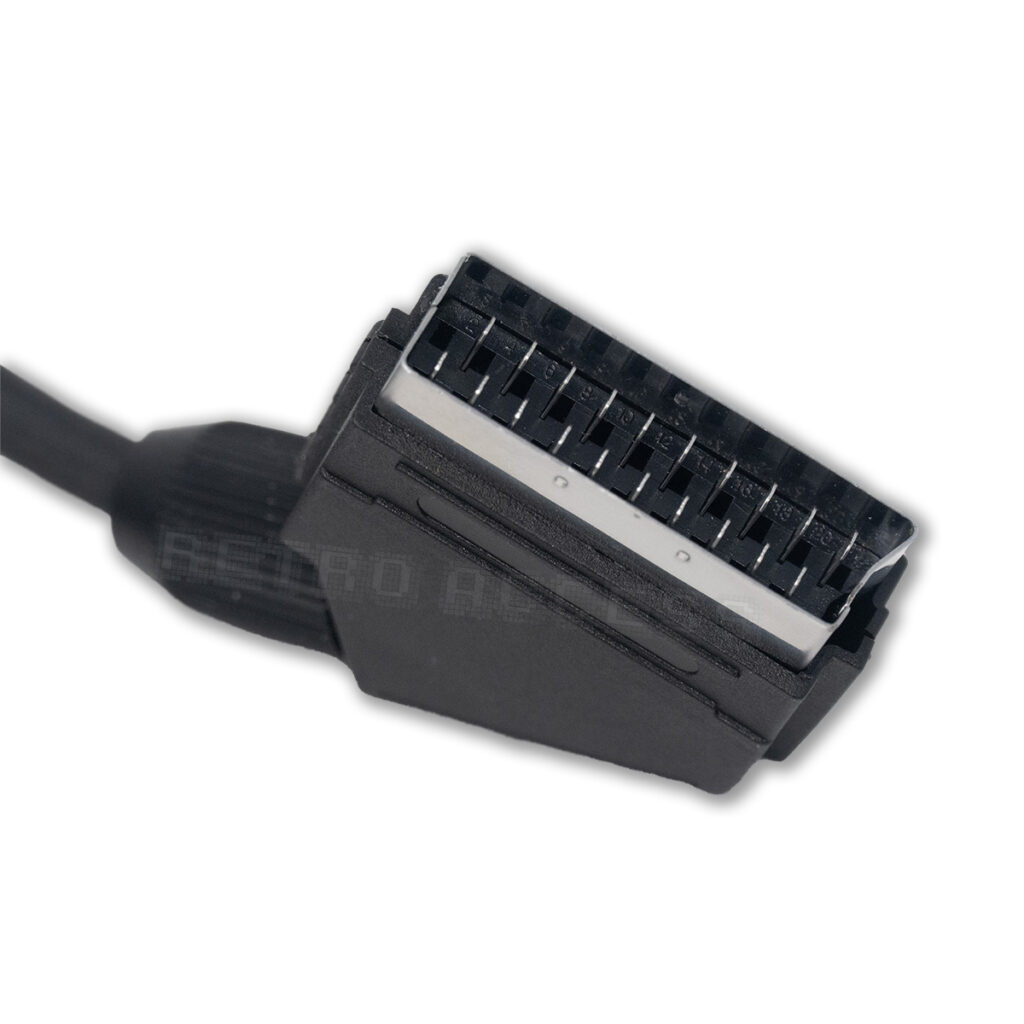
SCART is a 21 pin connector that provides a convenient method of supplying RGB video and stereo audio within a single connector. It is officially known as the Péritélévision connector, sometimes marketed as EuroSCART in consumer electronics. It is called Euroconnector in Spain, and in the United States it may be referred to as EuroAV, EXT or EIA Multiport.
The name “SCART” is an acronym of Syndicat des Constructeurs d’Appareils Radiorécepteurs et Téléviseurs, which translates to “Radio and Television Receiver Manufacturers’ Association”, the French organization that originally created the connector in the 1970s.
Electrical signaling and interconnection requirements are defined in BS EN 50049-1, Domestic and similar electronic equipment interconnection requirements: Peritelevision connector. The mechanical characteristics are further defined in IEC 60807-9, Rectangular connectors for frequencies below 3 MHz Part 9: Detail specification for a range of peritelevision connectors.
SCART Male Reference Pinout
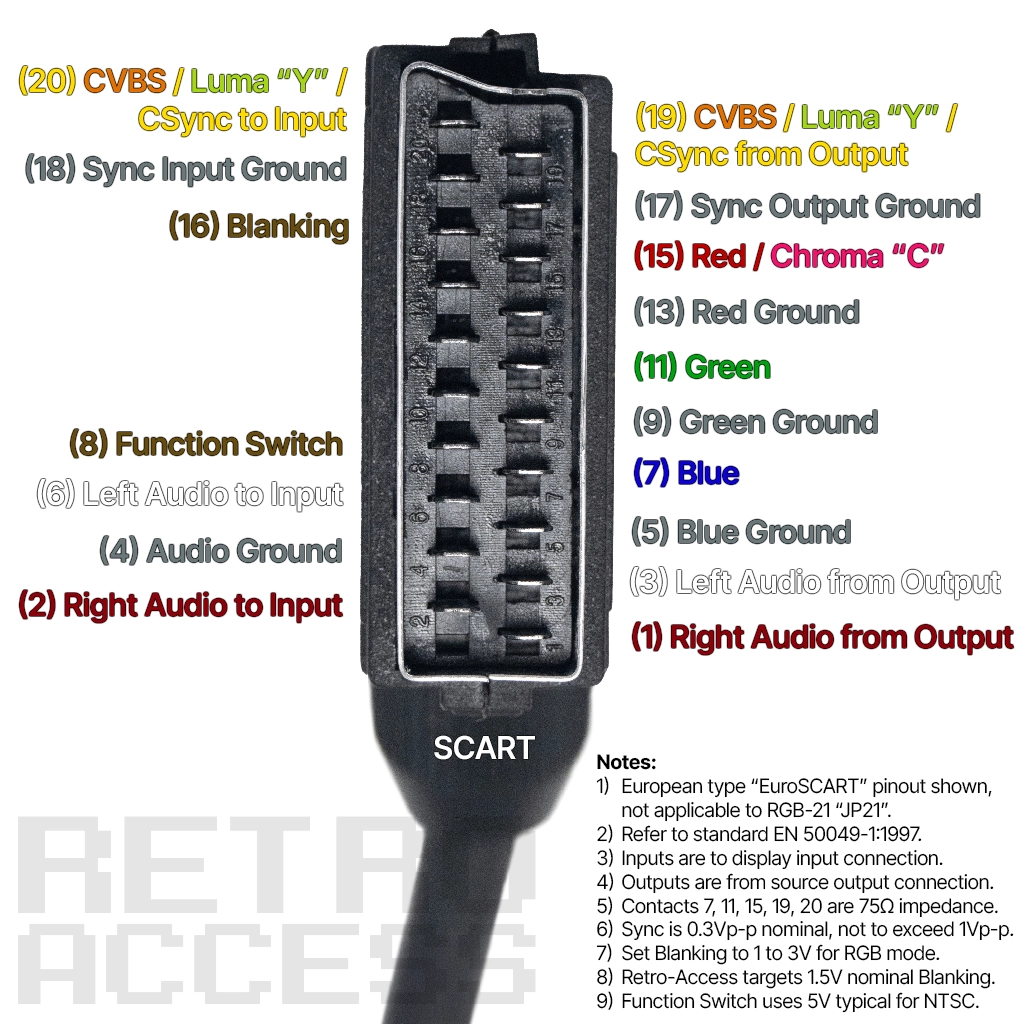
SCART cables use unidirectional audio and sync, meaning one end must be used from the source “output” (device, console) and the other end to the display “input” (television, switch, upscaler). Some low quality SCART cables use a “crossover” wiring method such that they can be plugged in either way, however this is not possible with Mini-Coaxial cable.
The “output” and “input” terminology can be confusing.
- Output: From a source device, such as a switch’s output connection. This is labeled as “From Source” on Retro Access cables.
- Input: Connected into a display or switch’s input connection. This is labeled as “To Display” on Retro Access cables.
Pin 8 is used for Function Switching, also known as AV Select or Aspect Ratio.
Pin 16 is used for Blanking, also known as Fast Switching or YS. This is a digital switch which tells the display whether composite or RGB is being provided by the source.
JP21 (Japan RGB 21-Pin)
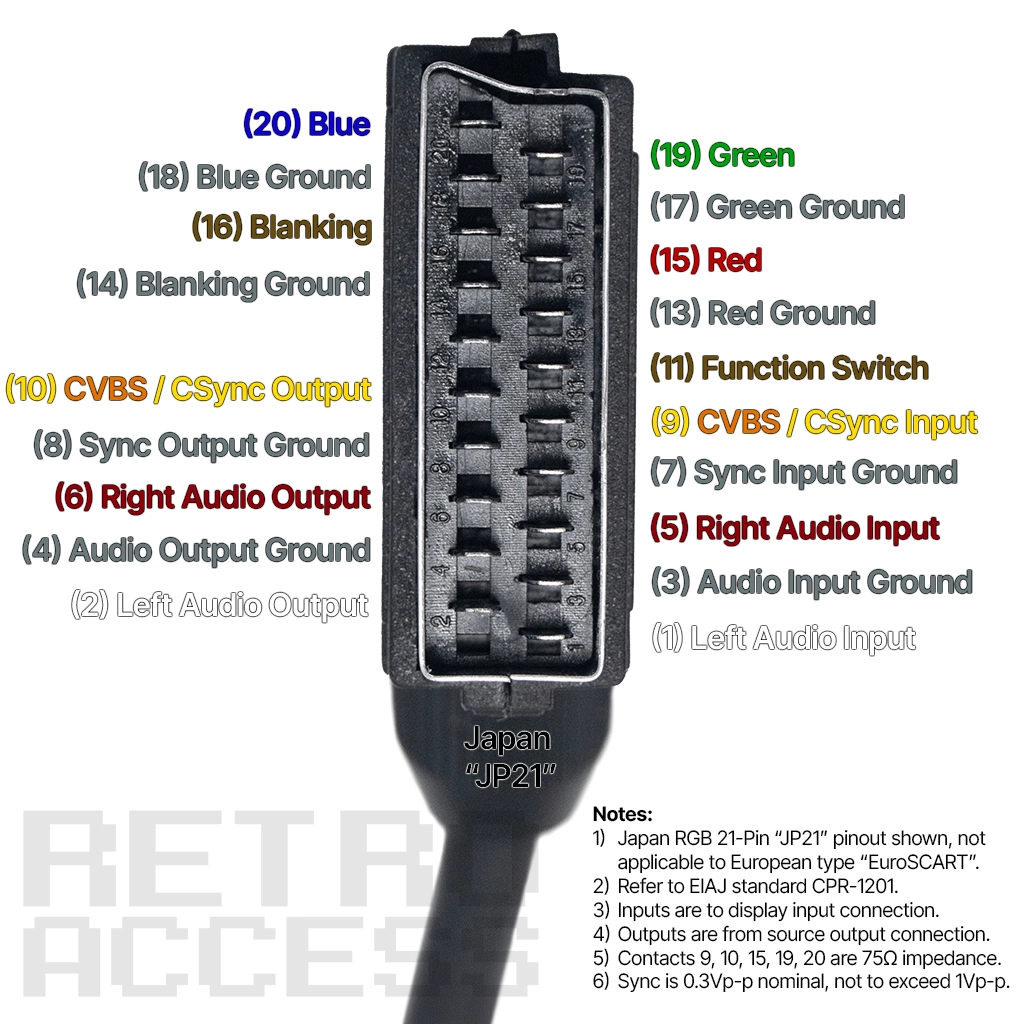
The same physical connector as SCART was used on Japanese electronics but with a different pinout, therefore it is not interoperable with SCART systems without the use of an adapter. The Japanese RGB connector is known as “RGB 21-Pin” or RGB21 for short, it is commonly referred to as JP21 in the west. It is defined in the Electronic Industries Association of Japan (EIAJ) standard TTC-0003 sometimes abbreviated as TTC-003, テレビジョン受信機とアナログ周辺機器との相互接続, Interconnection between television receivers and analog peripheral equipment. TTC-0003 was obsoleted in March of 1993 and superseded by CPR-1201.
RCA
RCA connectors are widely used in consumer AV setups for transmitting analog audio and video signals. They feature a simple friction fit push-on design that provides a connection without locking hardware.
However, a common complaint with RCA is difficulty finding the “Goldilocks Zone” for a secure fit, in other words, many connectors end up being loose easily slipping off, or experience frustrating “death grip”.
Composite Video (CVBS) uses a single RCA connector, typically yellow, to carry standard-definition video by combining all video information into one signal. Audio is carried separately, commonly using additional RCA connectors for stereo left and right channels resulting in a total of 3 connectors.
For higher quality video, Component Video (YPbPr) splits the video signal into three separate RCA connectors, usually colored green (Y), blue (Pb), and red (Pr) to deliver improved color accuracy and resolution. Audio is carried separately, commonly using additional RCA connectors for stereo left and right channels resulting in a total of 5 connectors.
BNC
BNC is a popular connector for professional AV applications, including broadcast, medical and editing. It may be rapidly connected and disconnected and will not pull free due to the turn lock mechanism. This is most commonly encountered on PVM and BVM monitors, and Extron Crosspoint matrix switch devices.
For RGBs signals four connectors are required, commonly referred to as “4BNC”.
Audio must be carried separately and is typically two RCA connectors, resulting in a total of 6 connectors.
D-Sub
Although there are many types of D-Sub connectors, the one we are concerned with is the DE-15 (HD15) type. This is commonly used to carry VGA (RGBHV) video, although in the context of retro gaming consoles it will carry RGBs video for a scaling device. RGBs is generally incompatible with VGA monitors.
Mini-DIN and DIN
Mini-DIN features a 9.5 mm metal shield with a keyed notch. Various types of Mini-DIN connectors exist.
Originally standardized by Deutsches Institut für Normung (DIN), the German Institute for Standards, “full size” DIN features a 13.2 mm metal shield with a keyed notch.
DIN Female Quick Reference
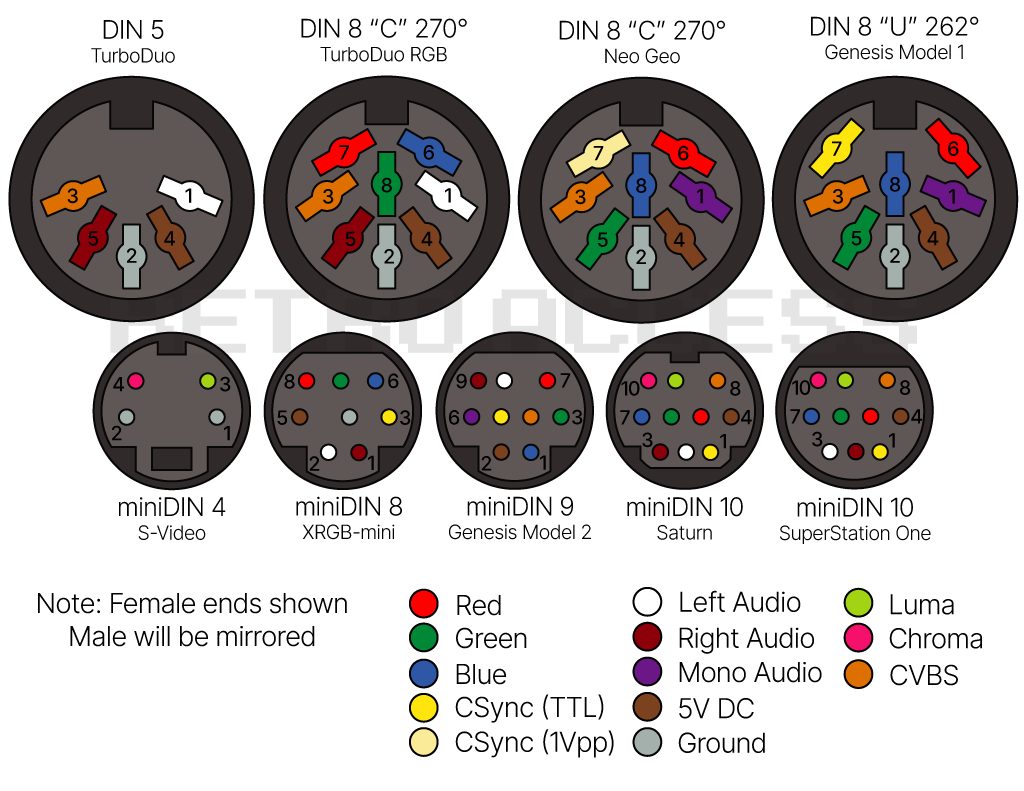
DIN Male Quick Reference
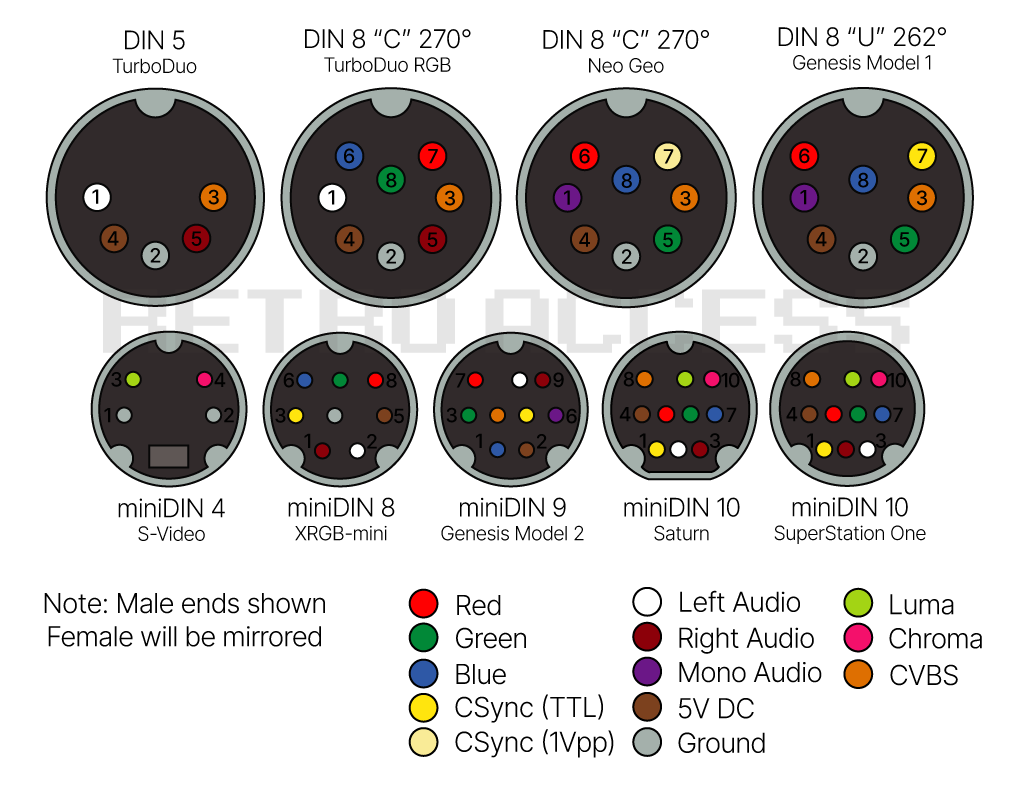
Mini-DIN 4 (S-Video)
Contains 4 pins, for Luma, Chroma, and respective grounds. The S-Video connector does not contain any audio and therefore a separate cable is required for audio.
Mini-DIN 9 (Genesis Model 2)
Found on the Genesis Model 2, 32X and numerous mods, the Mini DIN 9 connector features both mono and stereo audio, Composite Video (CVBS), RGB video, Composite Sync (CSync) and 5VDC. Ground is not assigned a dedicated pin and instead the outer metal shell is used for ground.
Mini-DIN 10 (saturn)
Found on the Saturn, SuperStation One and numerous mods, the Mini DIN 10 connector features stereo audio, Composite Video (CVBS), S-Video (Luma and Chroma), RGB video, Composite Sync (CSync) and 5VDC. Ground is not assigned a dedicated pin and instead the outer metal shell is used for ground.
This connector is often considered the “holy grail” of analog audio-video, as it offers S-Video, Composite Video, RGB video, and pure CSync all in a single connector, offering significant video signal flexibility.
It is important to note the Sega Saturn uses an off-standard female mini DIN 10 socket, however most male mini DIN 10 cables are compatible.
DIN 5 (TurboGrafx)
Found on the TurboGrafx, PC Engine, PC Engine Duo and Duo R, “full size” DIN 5 connector carries Composite Video (CVBS), stereo audio, ground and 5V DC. These consoles may be modified using upgrade kits to replace the DIN 5 with a DIN 8 for RGB video.
DIN 8 262° (Genesis Model 1)
Found on the Sega Master System and Genesis Model 1, the “full size” DIN 8 connector carries Composite Video (CVBS), mono audio, RGB video with Composite Sync (CSync), ground and 5V DC.
It’s important to note the connector has a physically different geometry (pin placement) compared to the DIN 8 270° connector, and the two are therefore incompatible.
DIN 8 270° (Neo Geo AES, TurboDuo RGB)
Found on the stock Neo Geo AES and CD, the “full size” DIN 8 connector carries Composite Video (CVBS), mono audio, RGB video with Composite Sync (CSync), ground and 5V DC.
Many common RGB mods, such as the Voultar PC-E DuoRGB Kit, for the PC Engine Duo and Duo R will use a DIN 8 270° female connector, however the pin assignment is different and therefore a Neo Geo AES cable is incompatible with PC Engine Duo RGB mods, and vice versa.
It’s important to note the connector has a physically different geometry (pin placement) compared to the DIN 8 262° connector, and the two are therefore incompatible.
Proprietary AV Connections
Manufacturers have designed their own proprietary methods which combine video and audio into a single convenient connector.
Nintendo AV Multi Out
Used on the New Famicom (“AV Famicom”), Super Nintendo (SNES), Super Famicom (SFC), Nintendo 64 (N64) and GameCube (GCN), the Nintendo AV Multi Out is an 11 pin connector which carries Composite Video (CVBS), S-Video (Luma and Chroma), RGB with Composite Sync (CSync), 5V and stereo audio. Because the connector housing is plastic, two dedicated ground pins are provided. Its multi-signal capability makes it a flexible solution for various display setups.
It’s important to note that NTSC consoles output CSync on pin 3, while PAL consoles will output 12V for “Function Switching” on pin 3. The two cables are therefore not interchangeable.
Wii AV Multi Out
The Wii 16 pin AV Multi Out port continues the tradition of a multi-signal connector, supporting Composite Video (CVBS), Component Video (YPbPr), 12V, 5V, and stereo audio. Because the connector housing is plastic, two dedicated ground pins are provided. Its multi-signal capability makes it a flexible solution for various display setups.
PAL Wii outputs RGB or YPbPr, but not S-Video. Mode pins 8/10 if shorted will output YPbPr on 7, 9, 11.
NTSC Wii outputs S-Video or YPbPr, but not RGB. Mode pins 8/10 if shorted will output YPbPr on 7, 9, 11. Therefore stock NTSC Wii consoles cannot be used with RGB SCART cables.
Sony PlayStation AV Multi Out
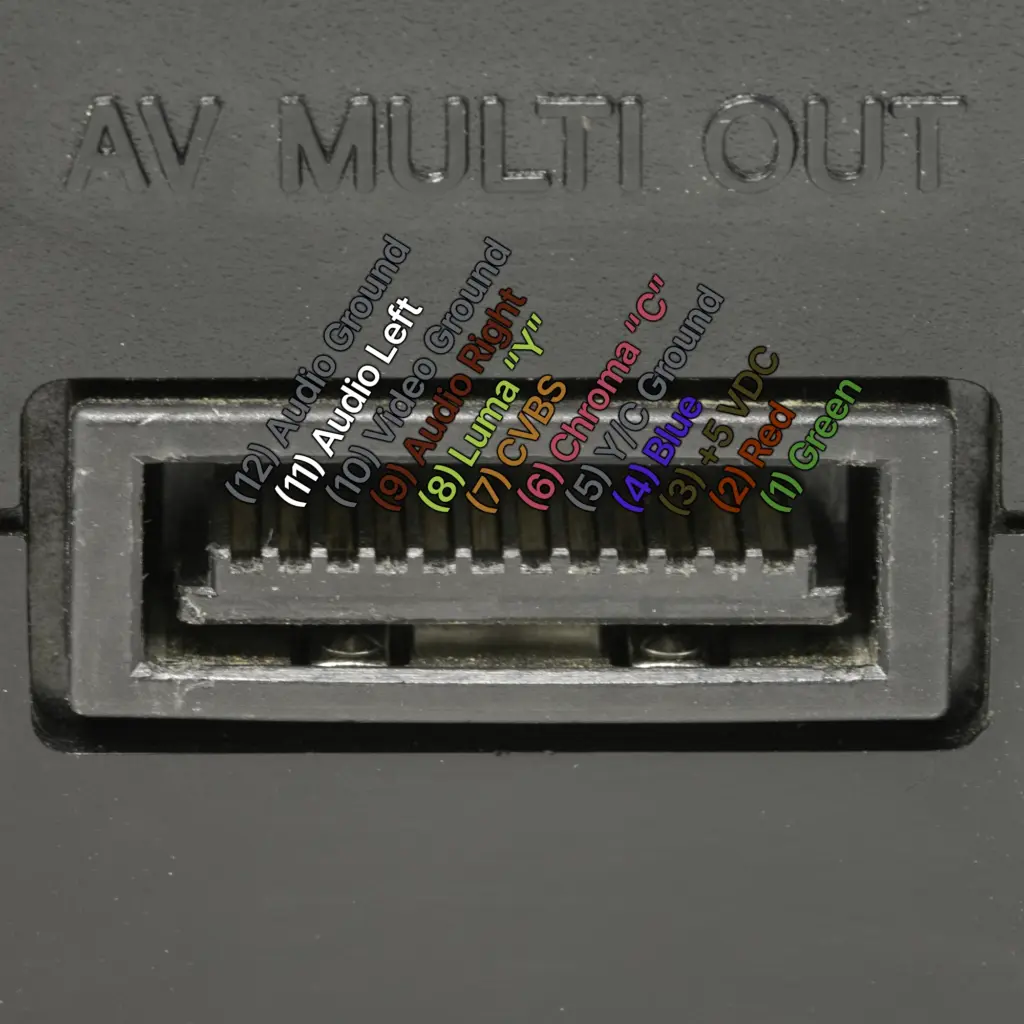
Found on the original PS1, PS2, and PS3 (early models), Sony’s 12 pin AV Multi Out connector supports Composite Video (CVBS), S-Video, RGB video, 5V and stereo audio. It notably does not output Composite Sync (CSync), so either CVBS or Luma is used for sync therefore requiring a sync stripper for use with Extron Crosspoint and certain displays.
When 480p (progressive scan, 31kHz horizontal scan rate) mode is enabled on the PS2, the console will disable the CVBS and Luma outputs and will switch to using Sync on Green. Sync on Green is not compatible with the Extron CrossPoint, XRGB-mini Framemeister or RetroTINK-5X Pro.
The PS2 also supports YPbPr mode (Component Video) which will use pin 12 for Y, pin 9 for Pb, and pin 11 for Pr. When using Retro Access cables, ensure your PS2 is set to “RGB” mode.
Dreamcast AV Multi Out
Sega Dreamcast 16 pin AV Multi Out port carries Composite Video (CVBS), S-Video (Luma and Chroma), RGB, Composite Sync (CSync) for 480i mode, Horizontal and Vertical Sync for VGA, 480p mode, 5V, 12V and stereo audio signals. This proprietary connector offers high versatility, supporting both standard and high-quality video outputs, including VGA for progressive scan displays. VGA (RGBHV) capabilities are not possible through SCART cables, however the Retro Access Dreamcast cable supports 480p 31KHz RGBs.